A sitemap for meaning: I built EntityMaps for two of my sites
Sitemaps list your pages. An EntityMap lists what they mean, with a quote from your own site behind every claim. I built one for aimantas.com and one for World Survey's 195 countries, and here's how to build yours.
 Aimantas · Product builder
- Visitors
- 17 Last 24 hours
- Revenue
- — Not split by project yet
The short version
- An EntityMap is a sitemap for meaning: one JSON file and one page that tell AI tools what your site is about, with a quote from your own pages behind every entry.
- I built one for aimantas.com (12 entities) and one for World Survey (223 entities, every country tied to its Wikidata item). The build rewrites both and refuses to ship if a quote stops matching.
- Building your own takes a list of what you are, a few quotes for each item and four signposts for crawlers. The steps are below.
Your sitemap lists pages. It doesn't say what they mean.
Search engines learned to read sitemaps long ago. AI assistants need something else: what your business is, in sentences they can quote.
That's the idea behind EntityMap, an open standard published this April. I came across it in a post by Emilis Zabilius, founder of the GEO agency Agenzy:
Three days after Agenzy published its entity map, ChatGPT was already pulling it. Five weeks in, he writes, it's the second most retrieved page of their site in the ChatGPT answers they track, right behind the homepage.
I had two sites that could use one, so I built two the day I read it.
The idea: hand AI the quotes yourself
AI search tools cut your pages into pieces and guess which ones describe you. An EntityMap hands them the pieces, already labelled.
Everything your site is about becomes an entity: the company, a product, a service, a place. Each one gets a short definition and up to five sentences quoted from your own pages, every quote tagged with the page it came from.
A sitemap for meaning
sitemap.xml lists your addresses. entitymap.json lists the things those addresses are about, and how they connect.
Receipts built in
Every claim comes with a quote and the page it's from. The standard asks AI tools to name you and link that page when they use it.
Speaks Wikidata
A sameAs link pins an entity to its Wikidata item, so your Cuba is the same Cuba every knowledge graph knows.
Anatomy of one entity
Here's Cuba from the World Survey map, cut to one quote:
{
  "entityId": "e_country_cub",
  "@type": "Place",
  "name": "Cuba",
  "description": "Cuba is an island country in the Caribbean, part of the Americas. Its capital is Havana.",
  "sameAs": "https://www.wikidata.org/wiki/Q241",
  "hasChunks": [{
    "text": "The capital of Cuba is Havana, at 23.13°N 82.37°W.",
    "sourceUrl": "https://geography.aimantas.com/countries/cuba/",
    "pageTitle": "Cuba: map, capital, flag and facts · World Survey",
    "publisher": "Aimantas"
  }]
}@typesays what kind of thing it is, from 15 types such as Place, Organization, Service and SoftwareProduct.sameAsties it to Wikidata item Q241.hasChunksholds the quotes, each with its page, title and publisher.
Entities also point at each other. World Survey is produced by Aimantas, Europe includes Latvia, Aimantas offers eight products. A flat list turns into a small knowledge graph.
Two maps in a day
A small map for this site and a big one for my geography game, both live on 24 November.
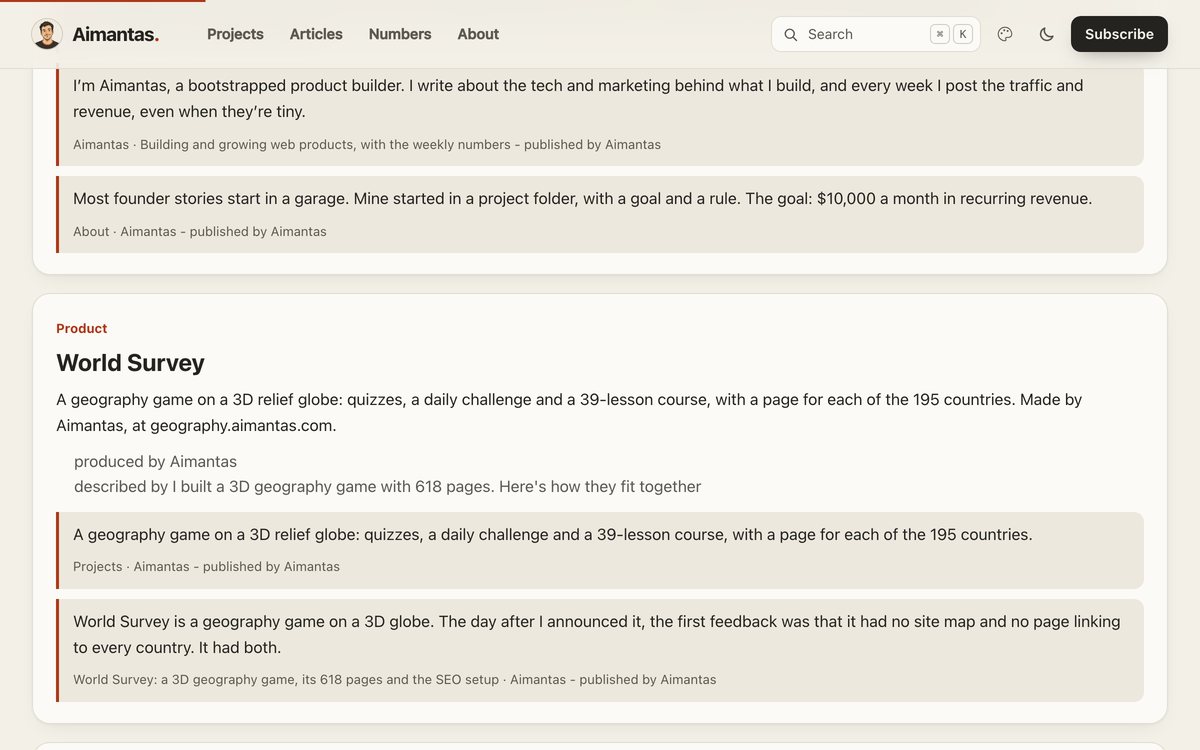
On aimantas.com the map covers Aimantas, the eight products, product builds and consulting, the weekly recap and my house rules.
On World Survey it covers the game, its 14 modes, the field course, its data sources, five regions and all 195 countries. Every country links to its Wikidata item and quotes its own page twice, so the map doubles as a small atlas.
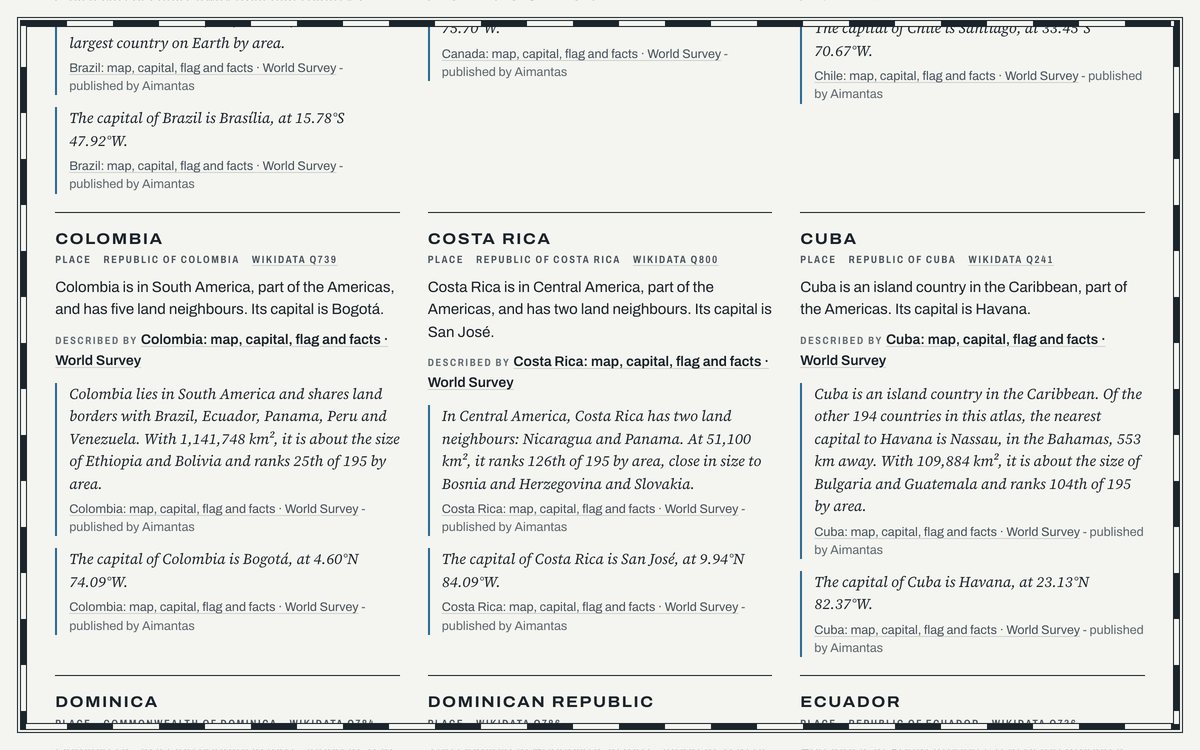
223 entities is past the point where the standard asks you to split the file, so World Survey's map comes in three parts. Each region sits in the same part as its countries, so their links stay together.
The part that keeps it honest
Both maps are rebuilt on every build, and the build refuses to ship if a single quote stops matching its page.
Emilis suggests sending Claude a weekly note about what changed. My sites are generated from data files, so the map is simply another file the build writes, right after the pages.
Every quote is lifted from a page the build has just written. Then a checker reads the pages again. Edit a sentence, change a title or delete a page, and the build stops and names the quote.
After each deploy, the same check runs against the live site:
12 entities, 24 passages checked on 10 live pages
entitymap ok
That's aimantas.com. World Survey's check reads 430 quotes back from 220 live pages.
Build one for your site
You need a list of what you are, a few good sentences for each, and four signposts that tell crawlers where to look.
- List your entities. The company, each product or service, your people, your prices and your terms. Start with the things you most want an AI answer to get right.
- Define each one in one to three sentences, the way you'd explain it to a new customer.
- Quote yourself. Pick up to five sentences per entity from your own pages, word for word, each with its address and page title.
- Pin it down. Add a Wikidata link where one exists, and relations such as OFFERS or PART_OF between your entities.
- Publish two files at the root of your site:
entitymap.jsonandentitymap.html, the readable version. - Put up the signposts: a link tag in every page head, a footer link, a line in robots.txt and an entry in your sitemap.
- Validate it at entitymap.org/validate, then keep it current, ideally from the same data that builds your site.
Three things that tripped me up
- The page answered with a redirect. My host turns
/entitymap.htmlinto/entitymap, and the standard wants the.htmladdress. Both sites now answer it directly. - The company had no relations. My code copied the list of Aimantas's relations before adding to it, so the map never said what Aimantas offers. The official validator caught it, pointing at 11 entities nothing linked to.
- The validator reads one file at a time. On World Survey it saw regions pointing at countries in another part and warned over 100 times. Keeping each region with its countries took both parts down to 2 warnings each.
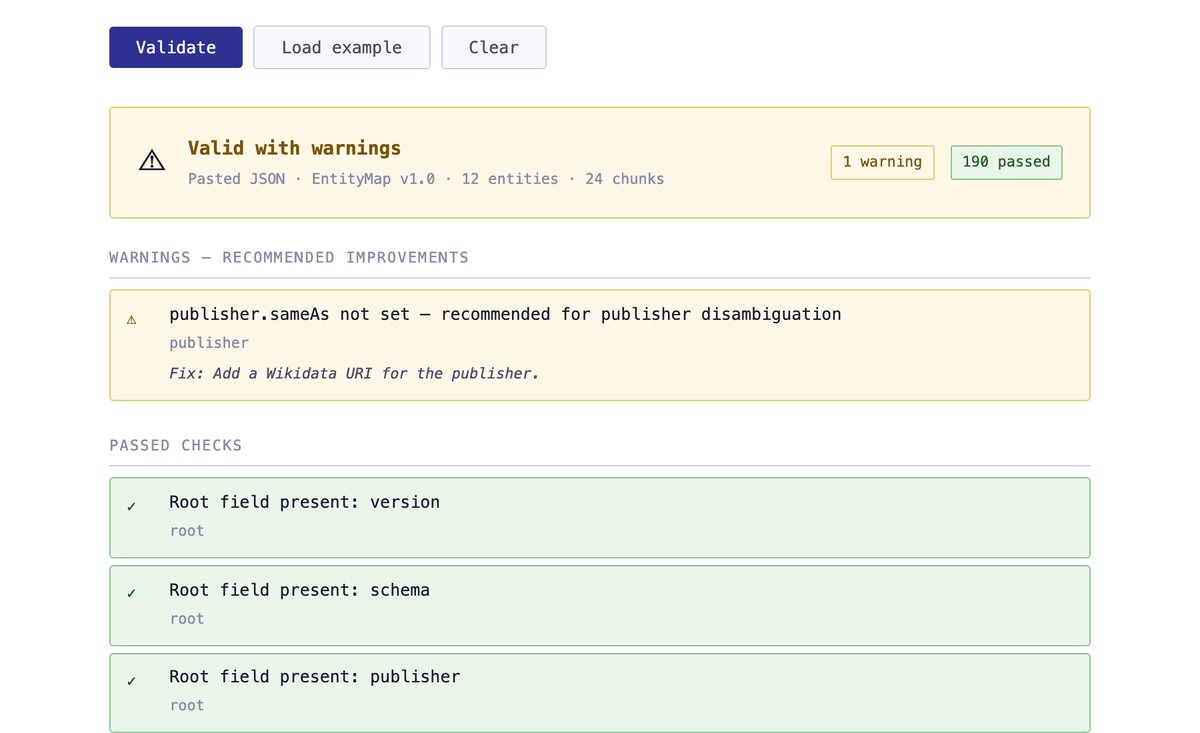
The one warning left wants a Wikidata entry for Aimantas. I'm not going to write one about myself.
What I'm watching
ChatGPT already sends World Survey 20 of its 54 weekly visitors. That's a good place to see whether the maps change anything.
The early numbers come from the people who build the tooling, and no AI company has said it reads these files yet. That's part of the fun of trying it now: it's cheap, every quote is checked, and the visits are easy to count. I'll share what the numbers do.
Sources7 references
- The original post: Emilis Zabilius, founder of Agenzy, on LinkedIn, 22 November 2026: https://www.linkedin.com/feed/update/urn:li:share:7530323156167847936/. Its claims are reported as his; the post gives no figures beyond its own tracking.
- EntityMap specification v1.0, stable since 7 April 2026, CC BY 4.0, by Fred Laurent and Dixon Jones: https://entitymap.org/spec/v1.0. Read 24 November 2026.
- Waikay's case study as reported by ppc.land, 4 June 2026: entitymap.html drew 6.5% of Gemini citations against 3.0% for the About page; ChatGPT, Copilot and Claude cited it zero times because Bing had not indexed the file. https://ppc.land/entitymap-beats-the-about-page-a-48-hour-ai-visibility-experiment/
- Primo Interactive, 9 July 2026: no AI engine, search engine or agent platform had announced support for EntityMap. https://www.primointeractive.com/blog/entitymap-open-standard-ai-search
- aimantas.com EntityMap, live 24 November 2026: 12 entities, 24 passages from 10 pages. Validator at entitymap.org/validate the same day: valid with warnings, 190 passed, 1 warning (publisher.sameAs not set).
- World Survey EntityMap, live 24 November 2026: 223 entities in a main file and two parts, 430 passages from 220 pages, 204 Wikidata IDs. Live check read every passage back from the live pages.
- Baseline, 7 days to 24 November 2026, from Plausible through this site's live numbers, top five sources per site only: World Survey 54 visitors, 20 from chatgpt.com; aimantas.com 16 visitors, none from an AI assistant.
Keep reading
All 21 articles →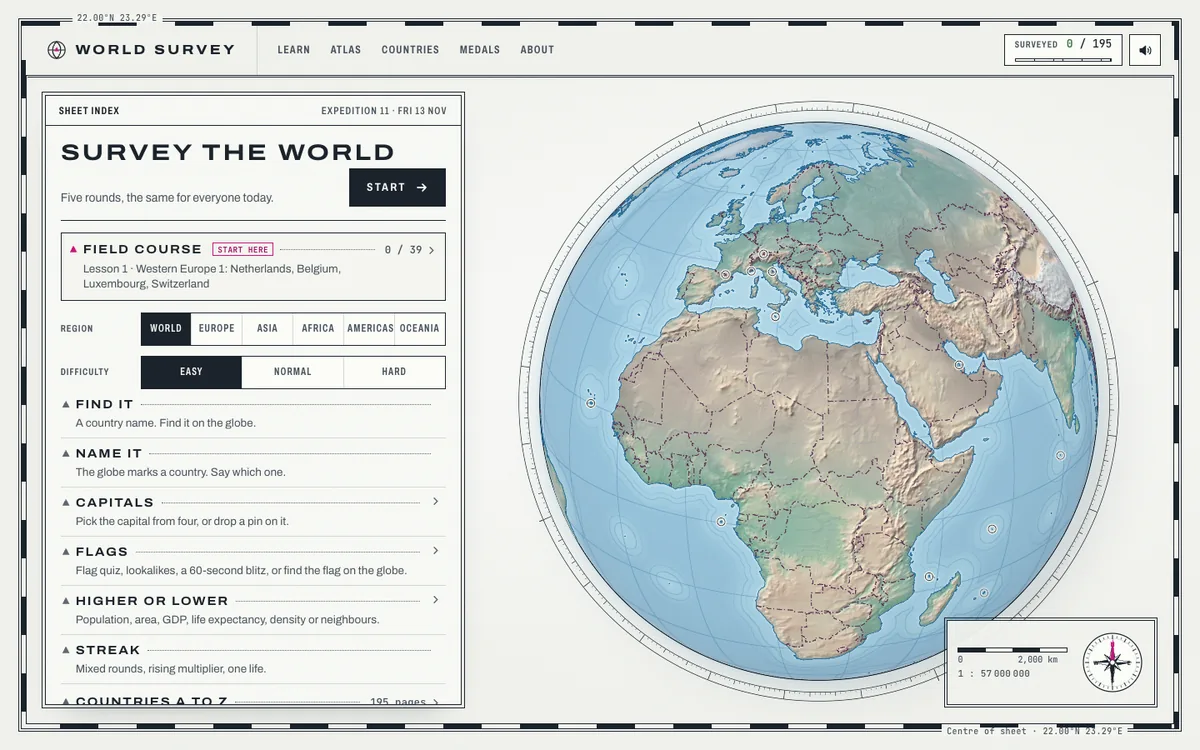
Older
World Survey is open source. Fork my 3D geography game
I put the whole of World Survey on GitHub: the web game, the iPhone app now in TestFlight, the data pipeline and the page generator. How to make your own map game from it, what the licences allow, a first week where ChatGPT sent more visitors than Google, and a preview of the iPhone app I'd like your feedback on.
18 November 2026Read →
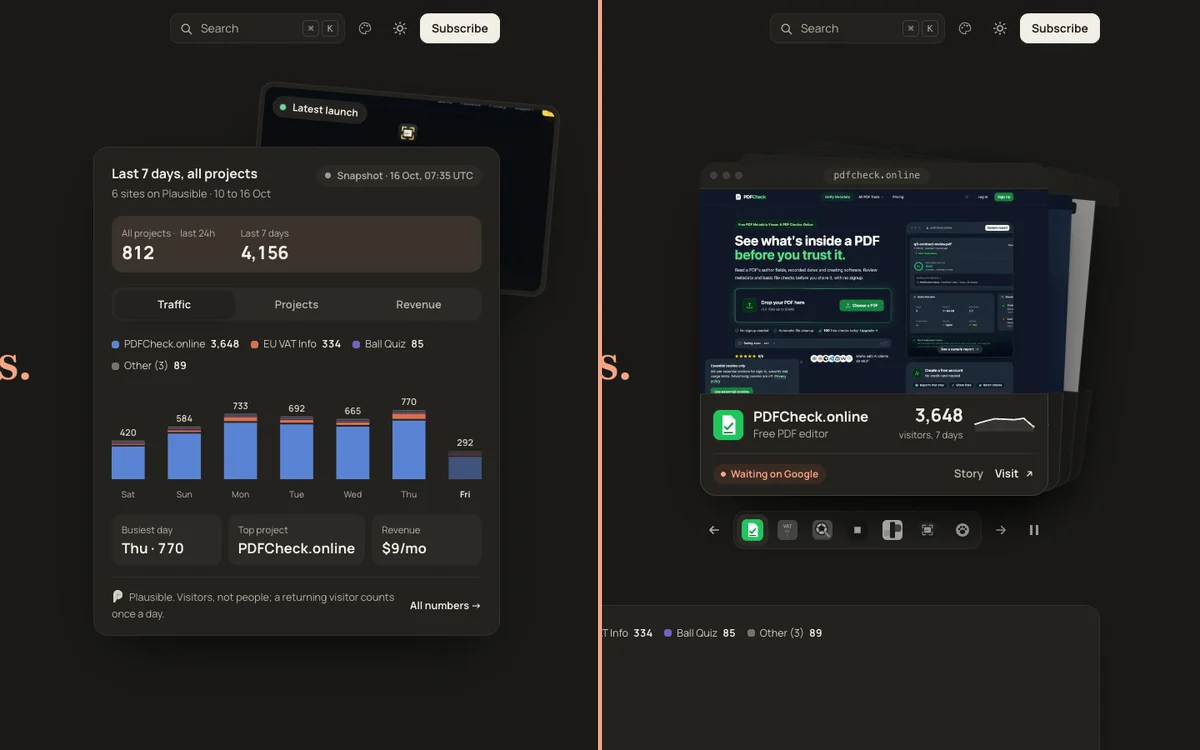
More on aimantas.com
I redesigned my homepage with Claude Fable 5.2. Before and after
One sentence of brief. The dashboard in my hero became a deck of seven real product screenshots, and the numbers moved into one band. Before and after screenshots, the four things that broke and what it cost in bytes.
10 November 2026Read →
More on aimantas.com
Hi, I'm Aimantas. This is my build journal.
A short intro: who I am, the goal I'm chasing and what you'll find here.
12 October 2026Read →