World Survey is open source. Fork my 3D geography game
I put the whole of World Survey on GitHub: the web game, the iPhone app now in TestFlight, the data pipeline and the page generator. How to make your own map game from it, what the licences allow, a first week where ChatGPT sent more visitors than Google, and a preview of the iPhone app I'd like your feedback on.
 Aimantas · Product builder

- Visitors
- — Counted since 12 Nov
- Revenue
- — Not split by project yet
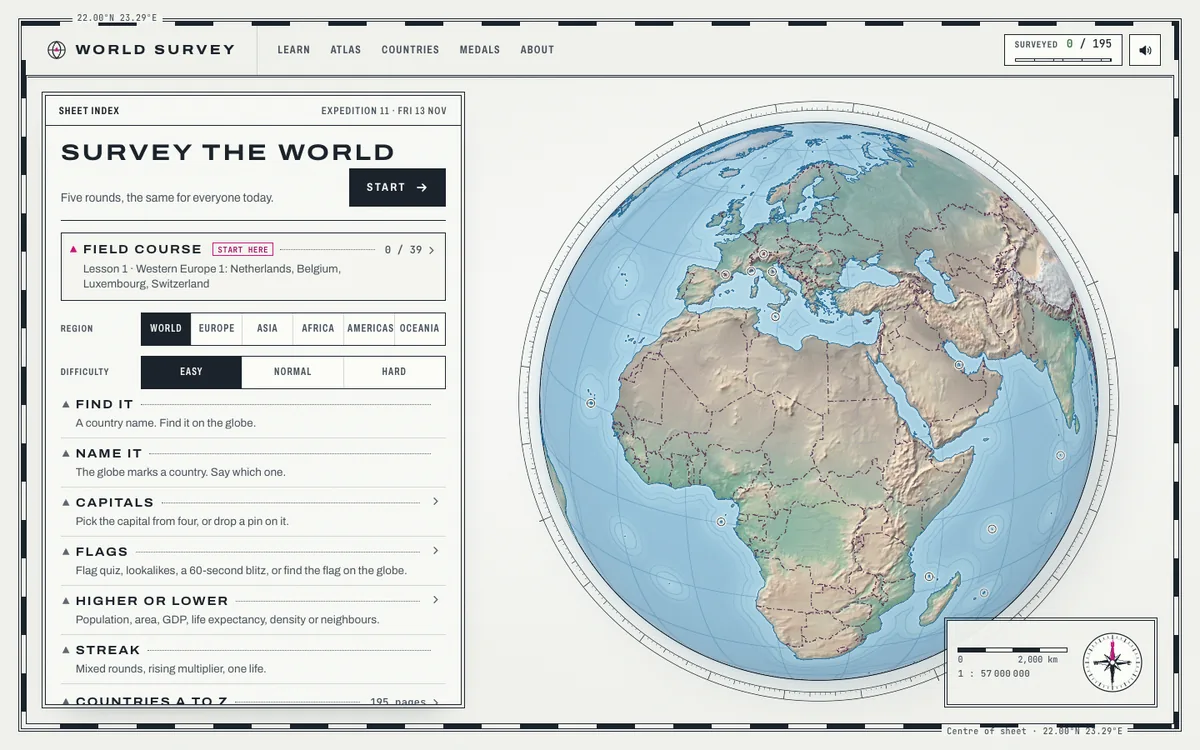
The short version
- World Survey's full source is public at github.com/aimantas/world-survey: the web game, the iPhone app, the data tools and the static page generator. The code is MIT; the country data is under the Open Database License.
- To make your own map game, add a mode, ask about other fields the countries already carry, swap the map for any TopoJSON, or restyle it. The pieces are separate on purpose.
- In its first measured week, 12 to 18 November, World Survey had 27 visitors and 11 came from chatgpt.com, more than from Google. The iPhone app is in TestFlight, and I'm asking for feedback before the App Store version.
The whole game is on GitHub now
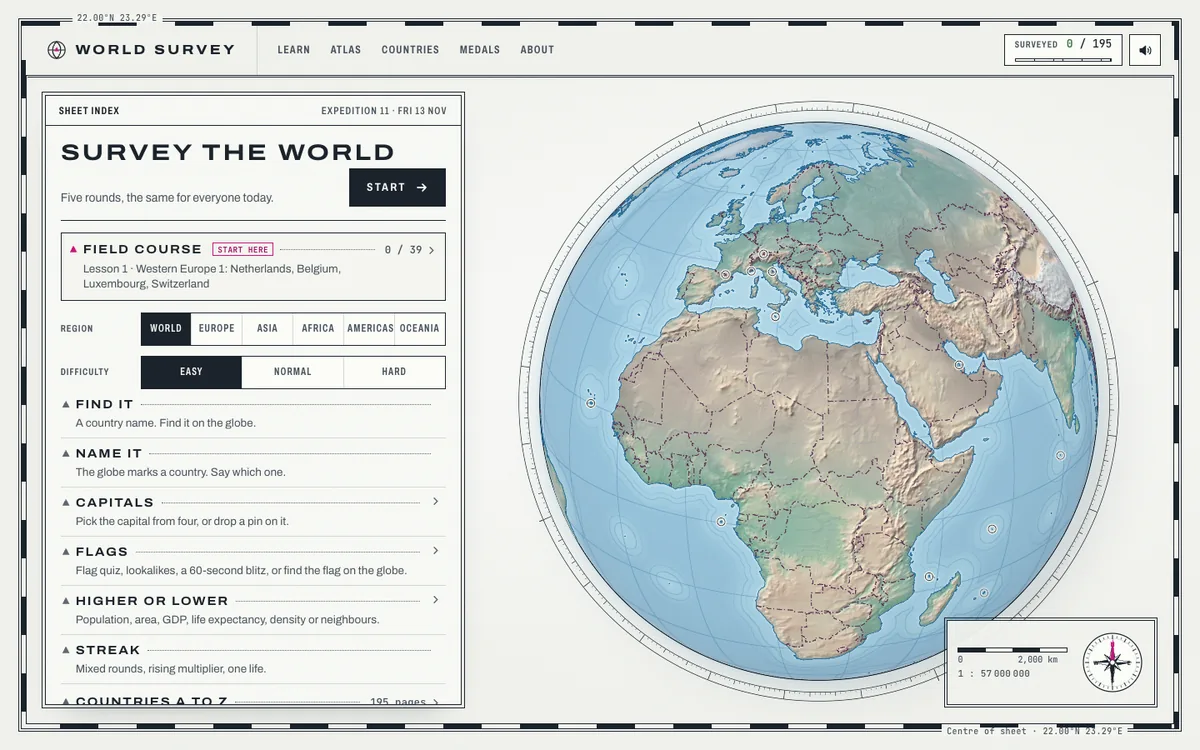
World Survey is open source. The web game, the iPhone app, the data pipeline and the generator for its static pages are all in one public repository.
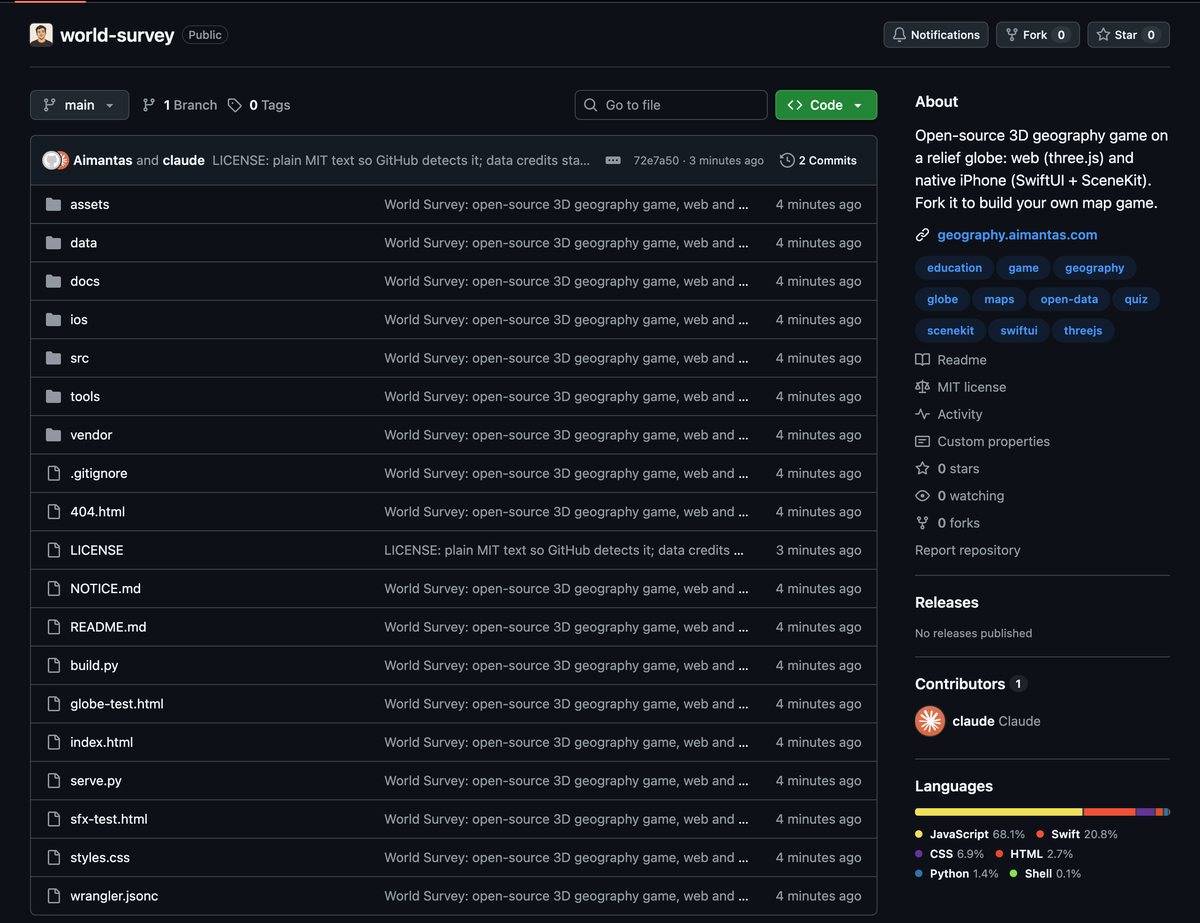
It's at github.com/aimantas/world-survey. I published it today, 18 November, so it has no stars, forks or issues yet.
I'm releasing it because a map game is a lot of plumbing before it's any fun: outlines, picking, a country table, flags, flights, scoring. That part is done. You can skip to the game you actually want to make.
- Web game. Plain ES modules and three.js, no bundler and no framework. It runs from any static host.
- iPhone app. SwiftUI and SceneKit, reading the same country table, course and scoring rules as the web game.
- Data tools. Node scripts that fetch the sources and build the table of 195 countries and 47 territories, the outlines and the relief imagery.
- Static pages. The generators for the 600-odd country, list and comparison pages, with the checks that fail a build when a page or a link goes missing.
I took out the parts that only make sense for my own site: the analytics address, the deploy settings and the list of private names my build checks look for. A fresh clone runs with Python alone; the full build also needs Node for the page generators.
Make your own map game from it
The pieces are separate on purpose, so most new games change one layer and leave the rest alone.
- Run it:
python3 serve.py, then openhttp://127.0.0.1:4462. The web game needs nothing but Python to serve it. - Add a question type in
src/game/modes.js. A round is built, answered and revealed insrc/ui/play.js, and scored insrc/game/scoring.js. - Ask about something else. Every country already carries its capital, population, area, GDP, life expectancy, borders, languages and currencies, so a languages quiz is a new mode over data that's already there.
- Swap the map. The globe takes any TopoJSON with an
iso3per shape. US states or historical borders keep the picking, highlights and flights. - Change the look. The design notes, colours and the globe's shader are documented, so you can keep the engine and drop my survey-map style.
Games I'd like to see built from it: US states and capitals, rivers and mountain ranges, borders through history, or a flag quiz for a classroom. If you make one, send it to me.
What you can reuse
The code is MIT. The country data is a different case, and the repository says so up front.
The country table mixes several open sources. Names, borders and languages come from the mledoze/countries project, which uses the Open Database License. So my tables carry that licence too: you can reuse and change them, but a database you build from them has to stay open under the same terms.
The rest is easier. Natural Earth outlines and relief are public domain, the figures are World Bank data under CC BY 4.0, the flags are MIT and the fonts are under the Open Font License. NOTICE.md in the repository lists every source and the credit it needs.
The first week: ChatGPT sent more visitors than Google
From 12 to 18 November, World Survey had 27 visitors. chatgpt.com sent 11 of them, more than any other source.
The numbers are small enough that a handful of people can change them. The order is still the surprise. Eight of my sites report into the same dashboard, and this week World Survey, one of the smallest, got more visits from ChatGPT than any of them.
PDFCheck had 2,894 visitors this week and 9 of them came from chatgpt.com. World Survey had 27, and 11 did. My dog training apps directory, another small site, had 5 visitors and 4 of them came from ChatGPT.
I can't see the conversations, only that the visit started on chatgpt.com. My guess is the country pages. Each one answers the plain questions people ask about a country, with the year and the source next to every number, and the site has an llms.txt that describes it to AI assistants. That's a guess until I can see which pages those visitors land on.
The iPhone app is in TestFlight, and I'd like your opinion
The native iPhone version is built and in TestFlight. Before it goes to the App Store, I want to know what you'd change.
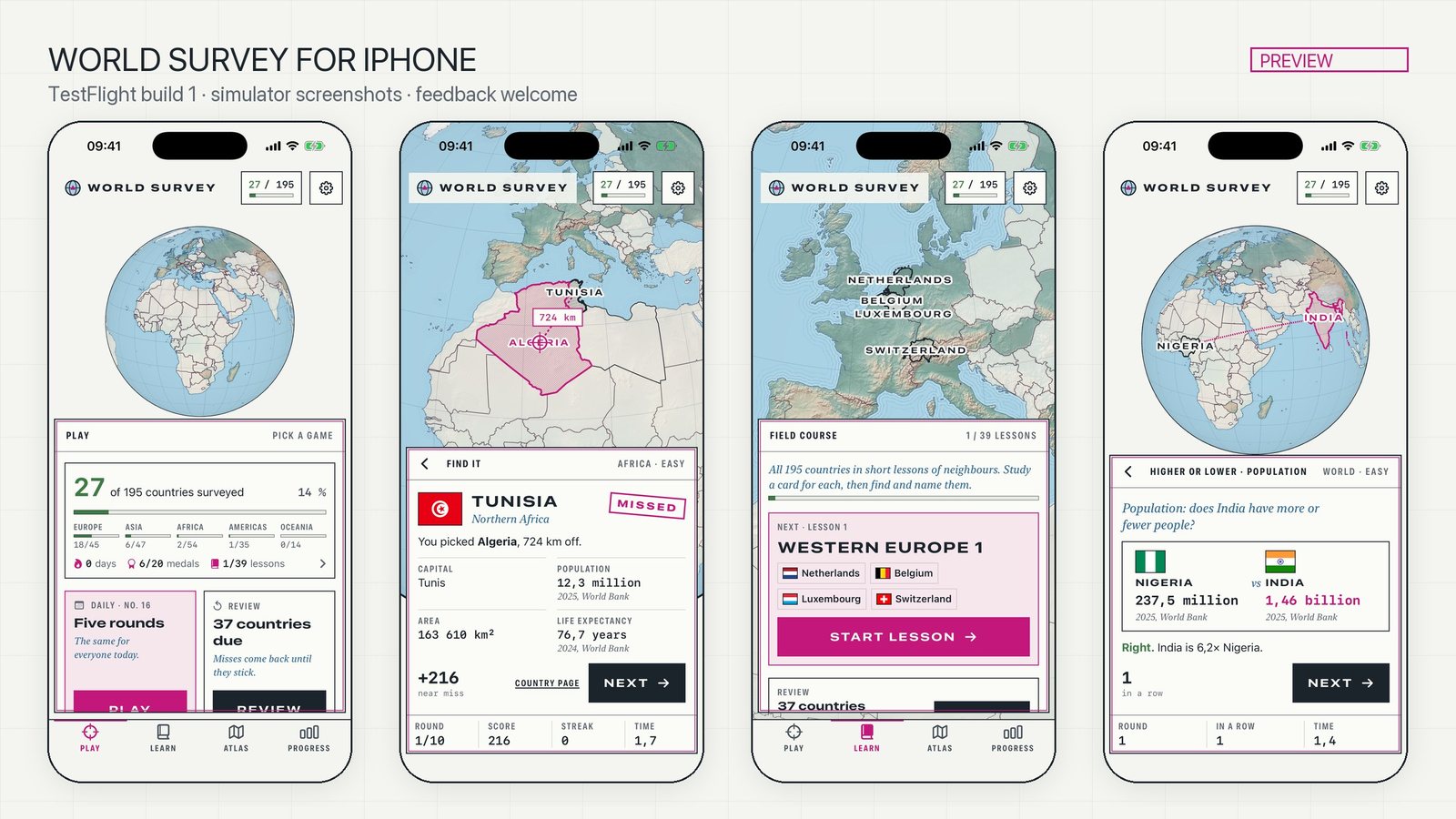
The globe is native SceneKit, the interface is SwiftUI, and the app reads the same data, course and scoring as the web game. The daily expedition gives you the same five countries on your phone as on the site.
It opens on four tabs. Play shows how much of the world you've surveyed, today's expedition and the games. Learn is the 39-lesson course, Atlas lets you look up any country, and Progress keeps your records and medals.
Here's what I'd like to hear from you:
- Which game would you open first, and which would you never touch?
- What's missing? Typed answers, a mode for two players, iPad, a widget for the daily?
- What would make you keep it on your phone after the first week?
Reply to me on X, open an issue on GitHub, or write to hello@aimantas.com. I'll use the answers to decide what goes into the first App Store version.
What happens next
Done
The source is public. A fresh copy builds the site, and the iPhone app's tests pass from it.
Not yet
The iPhone app isn't on the App Store, and I haven't run it on a real phone myself. TestFlight is where that starts.
Next
I read your feedback, pick what goes into the first App Store version, and find out which pages ChatGPT sends people to.
Where it stands 18 November 2026
Done
- Source public at github.com/aimantas/world-survey, MIT code and ODbL data (18 November)
- A fresh copy builds the site and its 619 sitemap URLs; the iPhone app's 8 tests pass from it (18 November)
- iPhone app build 1 in TestFlight (15 November)
Not done
- iPhone app not on the App Store, and not yet run on a real phone in my own checks
- The three-second auto next is in the repository but not on the live site
- No stars, forks or issues yet: published 18 November
Next
I read the feedback, pick what goes into the first App Store version, and look at which pages ChatGPT sends people to.
Sources6 references
- Repository: https://github.com/aimantas/world-survey, public since 18 November 2026. Checked signed out the same day: default branch main, two commits, MIT licence detected by GitHub, 0 stars and 0 forks. The screenshot was taken in a fresh headless Chrome profile with no sign-in.
- Build check, 18 November 2026: a copy of the repository built with `npm ci` in tools/ and `python3 build.py` (Node 24, Python 3): 1,740 files in dist/, 619 sitemap URLs. The pages /, /play/find/europe/, /countries/peru/ and /learn/ returned 200 from the local server. The iPhone app's unit tests ran from the same copy in the iOS 26.5 simulator: 8 of 8 passed.
- Licences: data/countries.json cites mledoze/countries 5.1.0 (ODbL 1.0), World Bank World Development Indicators (CC BY 4.0), Natural Earth (public domain), Wikidata (CC0 1.0) and flag-icons 7.6.0 (MIT). NOTICE.md in the repository lists the credits.
- Traffic: Plausible, read through aimantas.com/api/metrics on 18 November 2026 at 13:35 UTC. World Survey (geography.aimantas.com): 27 visitors from 12 to 18 November, daily visitors added up (1, 2, 9, 0, 1, 12, 2). Visitors by source over the same days: chatgpt.com 11, Direct / None 10, Google 5, Twitter 1, YouTube 1 (Plausible counts per source, so they add to 28). Counting started on the evening of 12 November.
- Other sites in the same read: pdfcheck.online 2,894 visitors, 9 from chatgpt.com; dog-training-apps.aimantas.com 5 visitors, 4 from chatgpt.com. Eight sites report to the dashboard.
- iPhone app: build 1 (1.0.0) uploaded to App Store Connect on 15 November 2026 and in internal TestFlight testing. The screenshots are the same code running in the iOS 26.5 simulator on an iPhone 17, captured 18 November with the status bar set to 9:41. It has not been submitted for App Store review.
Keep reading
All 20 articles →
Older
PDFCheck gave guests 100 free checks a day. Now it gives one.
Until 18 November anyone could run 100 PDF checks a day on PDFCheck without an account. What six weeks of uploads and two weeks of server logs showed, why one free file is the right trial for this tool, how I tested a limit of one, and who loses out.
18 November 2026Read →
More on World Survey
I built a 3D geography game with 618 pages. Here's how they fit together
A free geography game on a 3D relief globe, with country pages, lists and neighbour comparisons built from the same data. How the 618 pages are organised, what I set up for search, how it's meant to look, and the linking mistake I fixed the day after launch.
13 November 2026Read →
Related
PDFCheck for iPhone is live: 8 hours in the queue, 26 minutes of App Store review
My first iPhone app went from submit to approved in 8 hours 33 minutes, on the first try. The exact status timings, what I gave the reviewer, the month it sat before submission, and the checklist I'd reuse.
14 November 2026Read →