I built a 3D geography game with 618 pages. Here's how they fit together
A free geography game on a 3D relief globe, with country pages, lists and neighbour comparisons built from the same data. How the 618 pages are organised, what I set up for search, how it's meant to look, and the linking mistake I fixed the day after launch.
 Aimantas · Product builder

- Visitors
- — Counted since 12 Nov
- Revenue
- — Not split by project yet
The short version
- World Survey is a free geography game on a 3D relief globe: quizzes, a daily challenge and a 39-lesson course that teaches 195 countries as groups of neighbours.
- Around the game sit 618 pages built from the same data: a page per country, 12 lists, 314 neighbour comparisons and a real file behind every game address.
- The day after launch, the way to the country pages was one small link. I added a site map page, a Countries menu item and 195 direct links from the home page. There are no traffic or ranking numbers yet.
A game with 618 pages around it
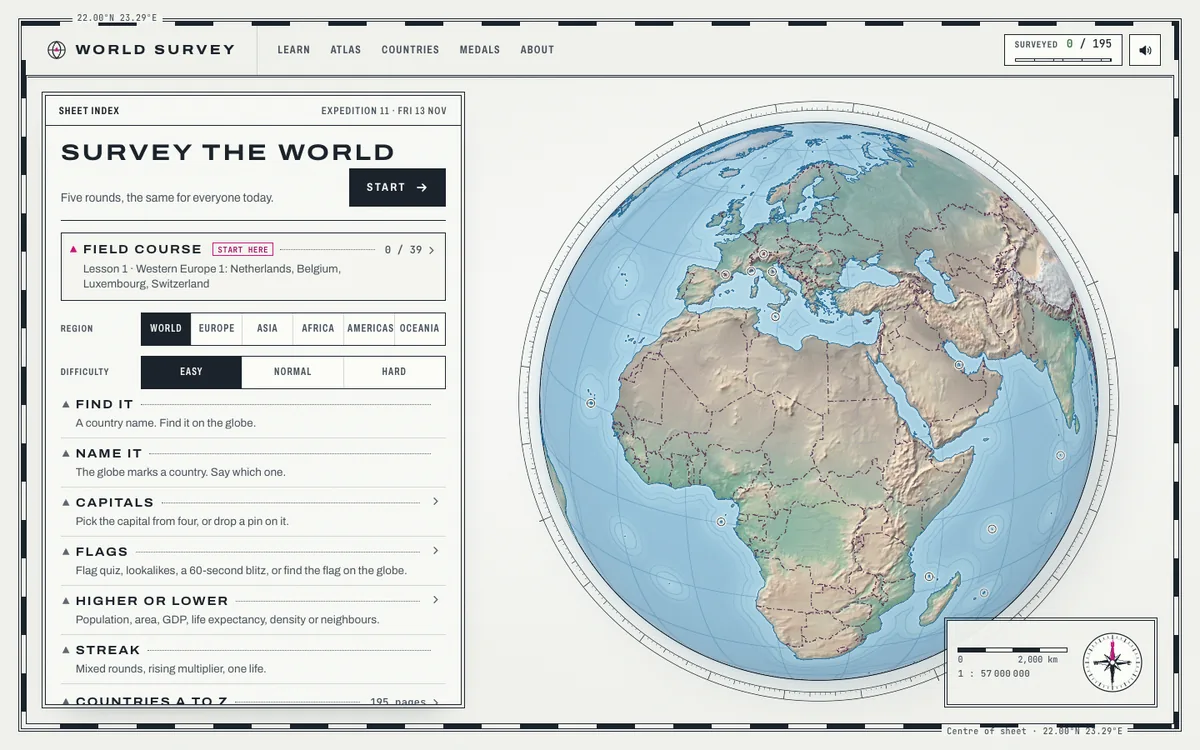
World Survey is a geography game on a 3D globe. The day after I announced it, the first feedback was that it had no site map and no page linking to every country. It had both.
The sitemap listed 618 URLs. The country index linked to all 195 country pages. I'd built them, checked them, and then left the way in as one small link under the list of games.
So here's the whole project in one place: the game, how its pages are organised, what I did to get them found, how it's meant to look, and what I changed that evening.
You answer on the globe
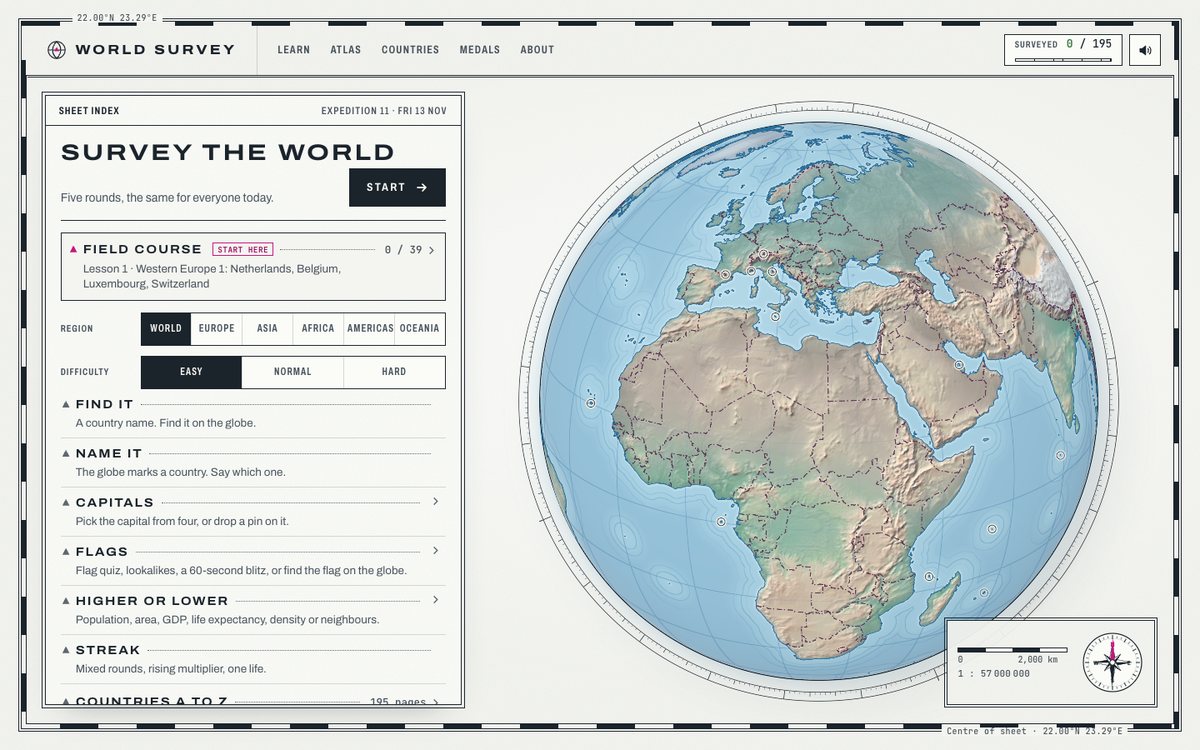
Every answer is a tap on the map. Find it names a country and you tap it. A wrong tap is scored by how far away it landed, so Belarus for Latvia costs less than Brazil for Latvia.
- Quizzes. Find it, Name it, capitals, five flag games, and Higher or lower on population, area, GDP, life expectancy, density or neighbours.
- Daily expedition. Five rounds, the same for everyone that day, with a grid you can share.
- Field course. 195 countries in 39 lessons of four to six neighbours. A country you miss is asked again before the lesson ends.
- Review. Countries you've missed come back after a day, three days and two weeks.
The course is my favourite part. An alphabetical list puts Latvia next to Laos. Here it turns up with Estonia and Lithuania, the way you'd find it on a map.
There are no accounts and no backend. Your progress stays in your browser, and after one visit the game starts offline.
One data set, seven kinds of page
The game and every page read the same record of 195 countries, so the capital you're quizzed on is the capital on the country page.
- 195Country pages
/countries/latvia/Map, capital, flag, figures, neighbours, questions - 6Country index and regions
/countries/europe/Every country, A to Z and by region - 24Game pages
/play/flagquiz/One address per game and chooser - 20Quizzes by region
/play/find/europe/Four games times five regions - 45Field course
/learn/northern-europe-2/39 lessons, five region pages, the course - 13Lists
/lists/landlocked-countries/12 rankings and lists, plus their index - 315Neighbours compared
/compare/estonia-vs-latvia/314 pairs that share a border, plus their index
Each kind of page is my guess at a question someone types into a search box. "Landlocked countries" is a list. "Estonia vs Latvia" is a comparison. "Latvia capital" is a country page. I don't know the search volumes, so they stay guesses for now.
Comparisons are the biggest group and the easiest to overdo. Every pair of 195 countries would be 18,915 pages, and most of them would have nothing to say. I built the 314 pairs that share a land border.
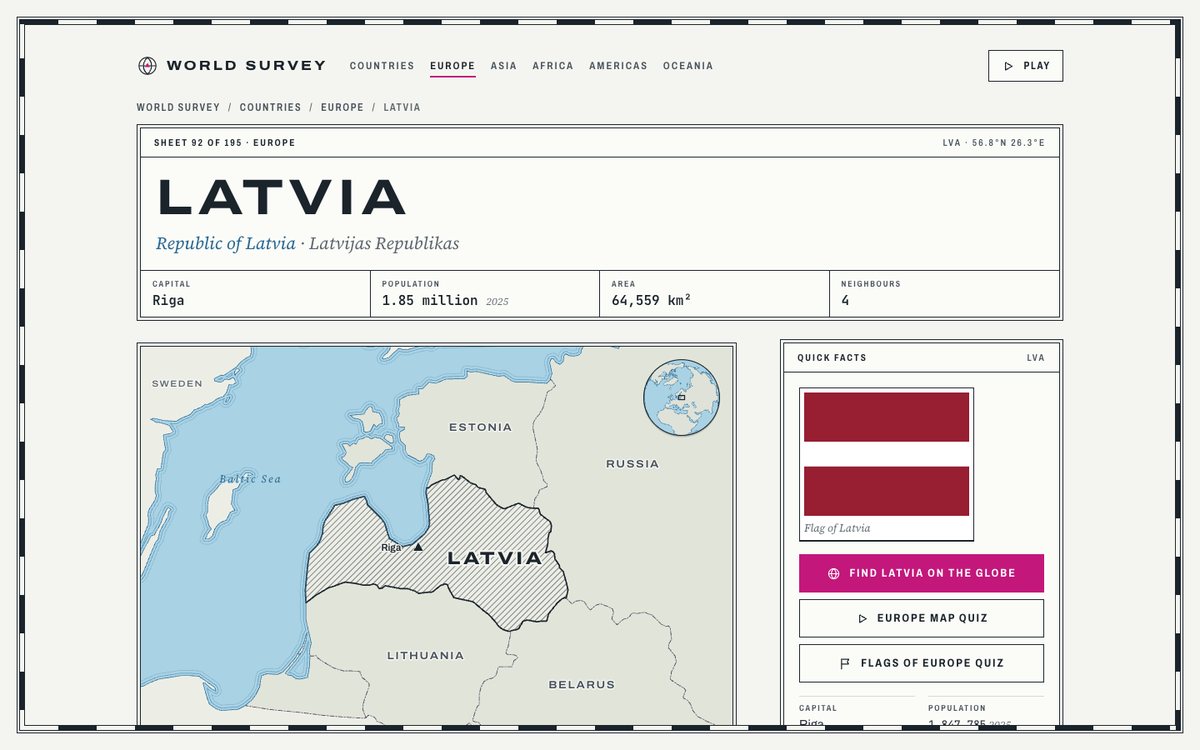
Every page links back into the game. A country page has a button to find that country on the globe and two quizzes for its region. A lesson page links to the pages of the countries it teaches.
The addresses are paths you can read. The Atlas has an address per country too, but those 195 point search engines at the country page, so the same facts aren't indexed twice.
A real file behind every address
The game draws itself with JavaScript. A crawler that doesn't run JavaScript would get an empty page, so the build writes a real one for every address.
Each file has its own title, description, canonical address and structured data. It also carries a short block of content: a heading, an introduction and links. On the Europe map quiz, that block lists the 45 countries of Europe, each linked to its page.
When the game starts, it replaces that block with the live screen. You never see it. A crawler sees what the page is for and where to go next.
The structured data says what each page is: a video game on the home page, a country with a questions block on country pages, a quiz, a learning resource for lessons, a list.
The mistake: pages only a crawler could find
Until 12 November the home screen had one link to the country index, in small type under the list of games.
Otherwise you met a country page only after a quiz round, from its fact card. The top menu had Learn, Atlas, Medals and About.
Typing /sitemap/ gave a 404, because the only site map was the XML file written for search engines. From a visitor's side the feedback was fair.
Before
- One small Countries link under the games
- Top menu: Learn, Atlas, Medals, About
- No site map page
- Home page to a country: two links
After
- Countries in the top menu, and a row on the home sheet
- A site map page linking to all 618 pages
- Site map link in every page footer, About and the 404 page
- Home page to a country: one link, for all 195
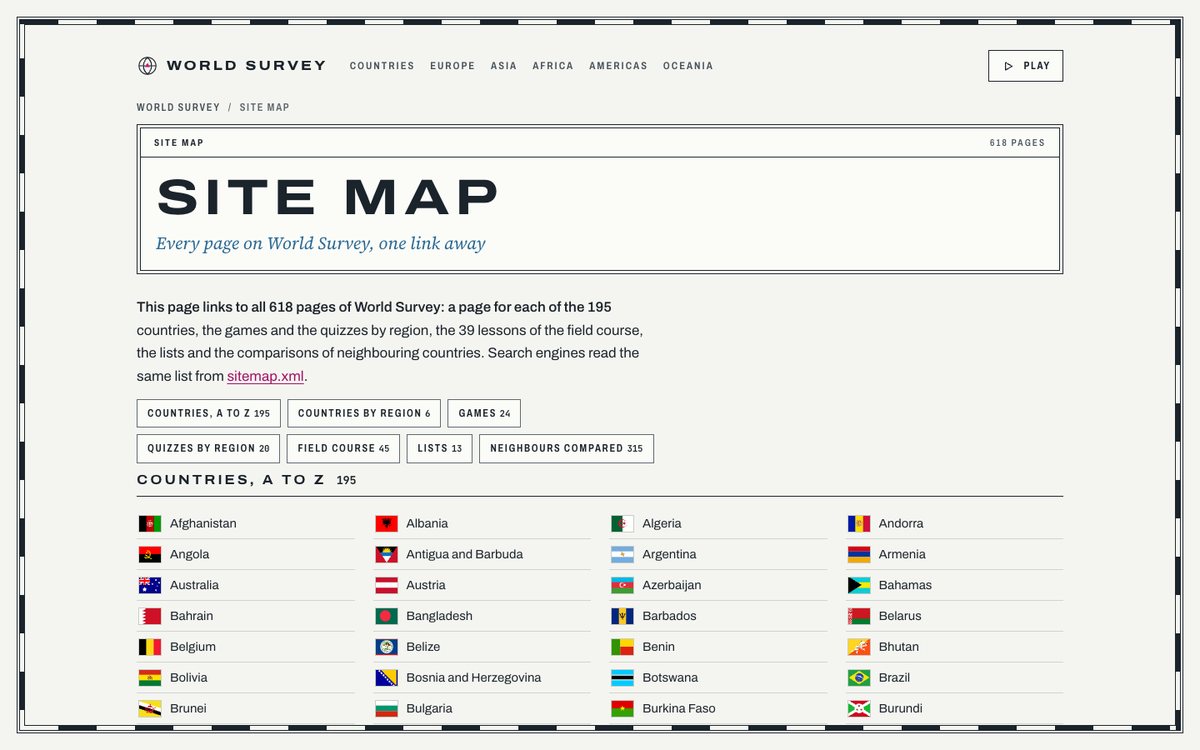
The site map page is written from the same list as the XML file. The build fails if a URL is in one and missing from the other, or if a page is linked twice. I can't forget to update it, because there's nothing to update.
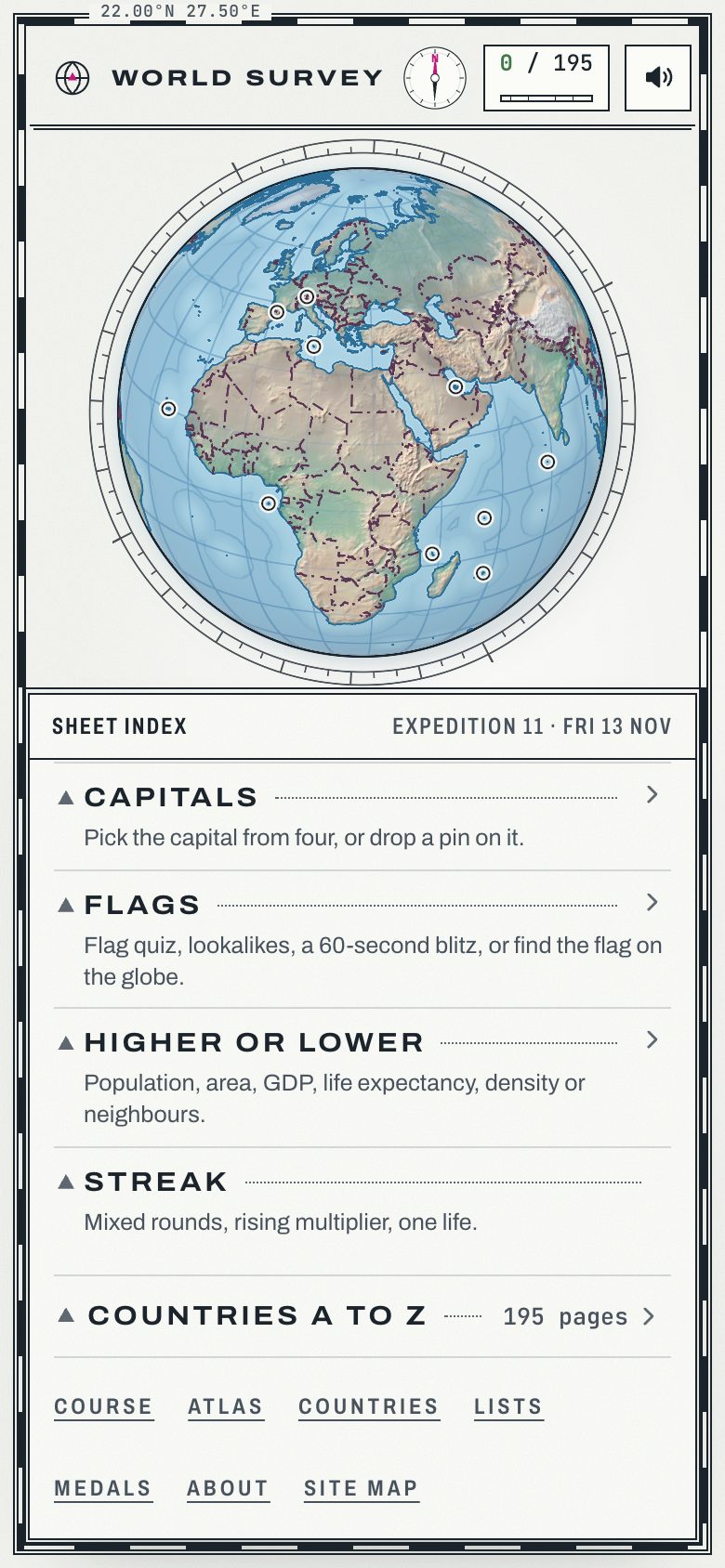
The home page change matters most for crawlers. Its HTML used to link to the country index, which linked to the countries. Now it links to all 195 directly.
What I did for search, and what I haven't
I don't have a ranking to show you yet. This is the setup.
- Sitemap. 619 URLs with their last-changed dates. Country pages list their flag as an image.
- Files for AI assistants. A 14.5 KB
llms.txtthat describes the site, and a second file with one line of facts per country. - Faster clicks. Speculation rules let supporting browsers prepare a static page while you hover over its link. Links into the game only fetch the HTML, so the globe doesn't start up for a click that never comes.
- IndexNow. I sent 618 URLs on 12 November and all 619 again on 13 November, after the linking change. Both were accepted.
- Google. I haven't submitted the sitemap in Search Console. IndexNow doesn't reach Google, so that's the next job.
Three scripts check every build before it ships. They work out which pages should exist from the game's own list of routes, the course and the country data, then fail the build if one is missing, has no title or breaks the footer.
Drawn like a survey map
The whole interface is one sheet of a survey map: paper, ink and a single magenta overprint.
The panel is the sheet index. The corner holds a scale bar and a compass. The margin shows the coordinates of the point the globe is centred on. A country page is headed "Sheet 92 of 195".
The globe has shaded relief, so the Alps and the Ethiopian Highlands look like high ground. That costs something: the build is 80.6 MB, and 41.9 MB of it is elevation imagery.
The results screen follows the same idea. It's a survey report with a rank stamp, your accuracy and the route you took across the globe.
The clip at the top of this page is the launch post: one lesson, played once and not edited. Five countries, five study cards and three quiz rounds, one of them missed on purpose so you can see the distance drawn.
What I can't tell you yet
Worked
One data set behind the game and the pages. I changed the linking in an evening because every page comes out of the same build.
Missed
I checked that the pages existed and never tried to reach one from the home screen like a visitor would.
Unknown
Whether any of it gets found. Visits have been counted since the evening of 12 November, which is too short to report.
What happens next
I submit the sitemap to Google. Then I wait, and look at which kind of page gets found first: countries, lists, comparisons or quizzes. My guess is the lists.
Where it stands 13 November 2026
Done
- Live at geography.aimantas.com (checked 13 November)
- 619 URLs in the sitemap, and a site map page that links to the other 618; the build fails if the two lists differ
- Site map linked from every page footer, About and the 404 page; the home page links to all 195 country pages (12 November)
- Every URL sent through IndexNow on 12 and 13 November, accepted both times
Not done
- Sitemap not submitted in Google Search Console
- No traffic, ranking or play numbers yet: visits counted since the evening of 12 November
- Not played on a real phone; sound not listened to
Next
I submit the sitemap to Google, then look at which kind of page gets found first.
Sources8 references
- World Survey, https://geography.aimantas.com/. Checked live on 13 November 2026: the home screen, a lesson, a country page, a list, a comparison and the site map page loaded and were captured in Chrome at 1440 × 900 pixels, and the home screen at 390 × 844 through device emulation. Analytics requests were blocked for those visits.
- Page counts from the 12 November 2026 build: 619 sitemap URLs. That is 195 country pages, 6 country index and region pages, 24 game pages, 20 region quizzes, 45 course pages (the course, 5 regions, 39 lessons), 13 list pages (12 lists and their index), 315 comparison pages (314 pairs of land neighbours and their index) and the site map page. Another 195 Atlas addresses are kept out of search indexes and name the country page as their canonical address.
- Linking before and after: in the 11 November version the game menu was Learn, Atlas, Medals and About, the home sheet had one Countries text link, /sitemap/ returned 404 and the home page HTML linked to the country index. Changed and deployed on 12 November 2026. Checked in production on 13 November: 195 country links in the home page HTML.
- Search files in the same build: robots.txt names 15 crawlers and allows all of them; llms.txt is 14.5 KB and llms-full.txt 73.9 KB; 195 share images; structured data types VideoGame, Country, FAQPage, Quiz, LearningResource, ItemList, CollectionPage and BreadcrumbList.
- IndexNow: 618 URLs submitted on 12 November 2026 (the first request returned 403, the retry HTTP 200) and 619 on 13 November 2026 (HTTP 200). Google Search Console: sitemap not submitted as of 13 November.
- Build size on 12 November 2026: 1,741 files, 80.6 MB, of which 41.9 MB is elevation imagery. Data: World Bank indicators (latest value per country, so years differ), Natural Earth 1:50m boundaries, flag-icons.
- Screen recording: one play-through of lesson 4, Northern Europe 2, on the live site on 12 November 2026, in headless Chrome at 1440 × 810 pixels. Answers were sent by the recording script, so no pointer is visible; the Latvia round was missed on purpose. Scaled to 960 × 540 for this page.
- Launch post, 12 November 2026: https://x.com/aimantasai/status/2120965201554198532. Visits are counted with cookie-free Plausible from the evening of 12 November; no figures are reported here.
Keep reading
All 20 articles →
Newer
Opus 5.5 built three of my sites. Fable 5.2 redesigned them
Three sites Opus 5.5 built, one Fable 5.2 session each. A quiz hero became the first question, a geography game got a whole learning loop, and a PDF tool page took two human nudges to get bolder.
13 November 2026Read →
Older
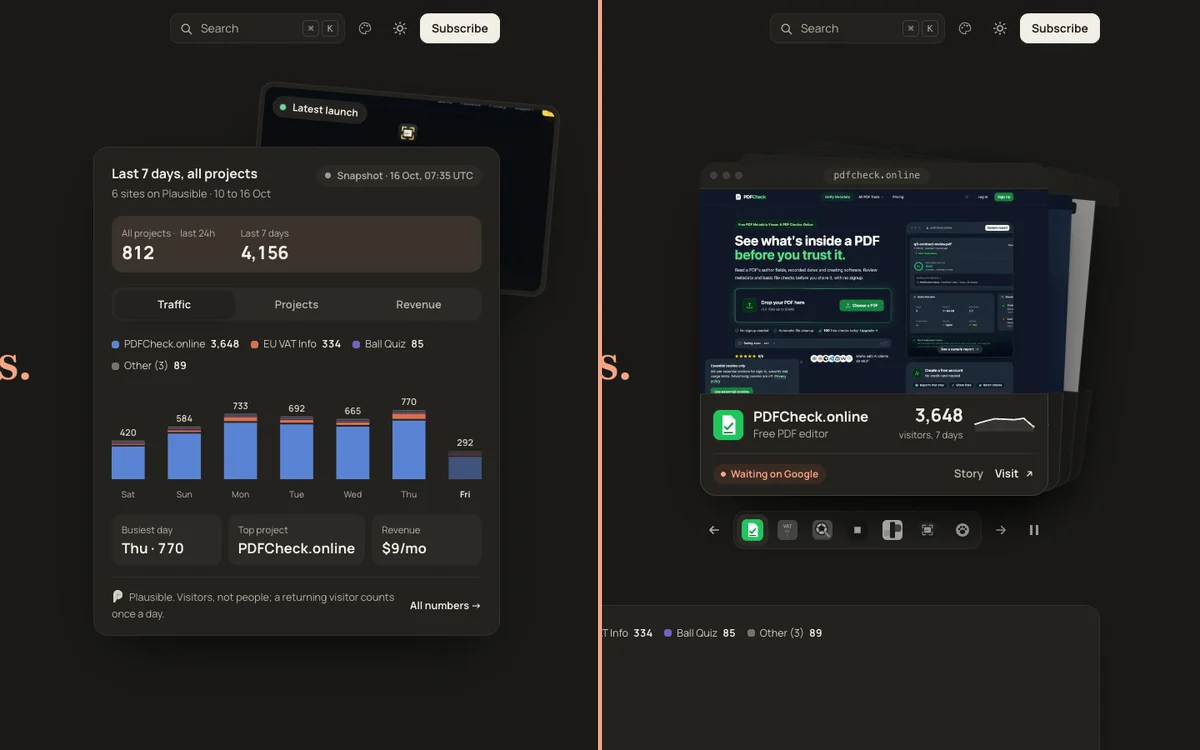
I redesigned my homepage with Claude Fable 5.2. Before and after
One sentence of brief. The dashboard in my hero became a deck of seven real product screenshots, and the numbers moved into one band. Before and after screenshots, the four things that broke and what it cost in bytes.
10 November 2026Read →
More on World Survey
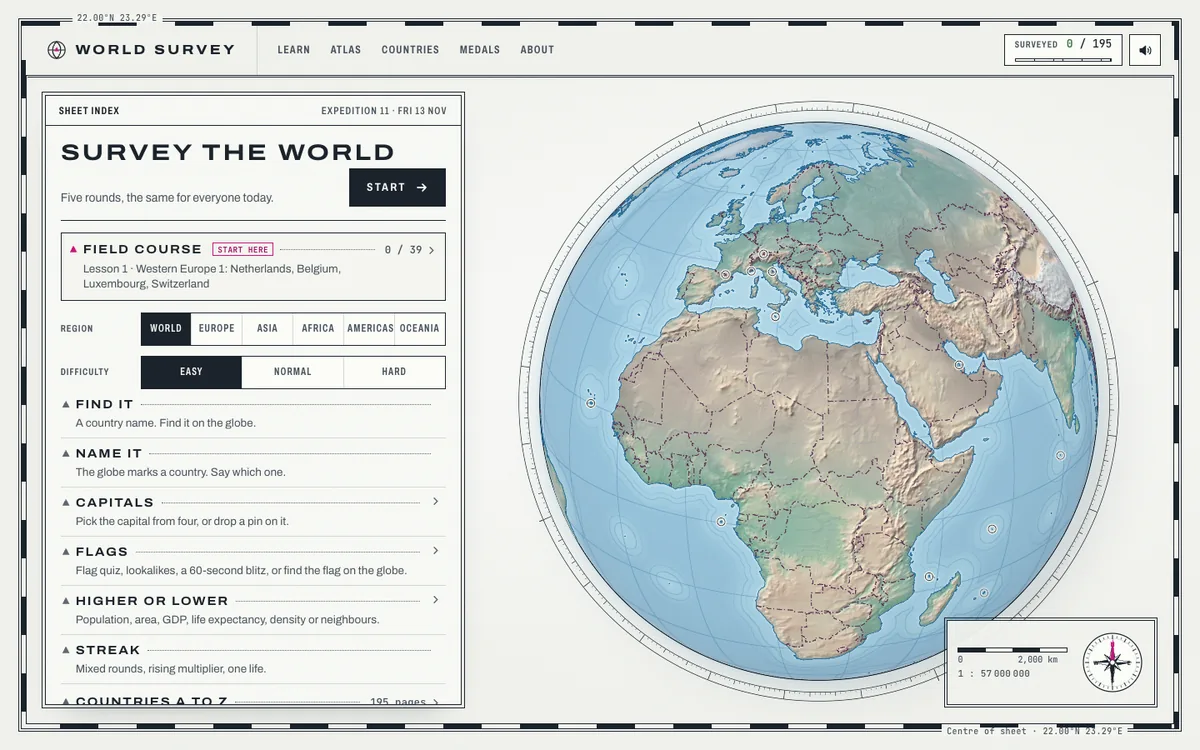
World Survey is open source. Fork my 3D geography game
I put the whole of World Survey on GitHub: the web game, the iPhone app now in TestFlight, the data pipeline and the page generator. How to make your own map game from it, what the licences allow, a first week where ChatGPT sent more visitors than Google, and a preview of the iPhone app I'd like your feedback on.
18 November 2026Read →